From the Silk Road to the age of shipping, trade routes have always moved more than goods—they have spread culture and ideas. Today, logistics is a multi-trillion-dollar industry, covering everything from global shipping to the delivery of fresh food. In Japan, logistics plays a crucial role. Long supplying the world with everything from traditional crafts to cars and electronics, Japan’s port cities such as Yokohama, Kobe and Nagoya have grown to become key trade hubs, with the latter alone handling over 150 million tons of cargo annually—88% of it destined for international markets.
Within Nagoya’s thriving logistics hub, solutions provider Trancom has long played a key role for 70 years, guided by its mission to “Connect, Transport and Create,” and is now focused on pressing challenges such as sustainability and labor shortages. As President Yasuhiro Jinno puts it, “The core idea of all the services we provide is efficiency.”
“We have a nationwide network which allows us to quickly respond to client needs, even in emergencies.”
– Yasuhiro Jinno
A central pillar of Trancom’s strategy is its promotion of “3PL” (Third-party Logistics), in which functions such as warehousing and transportation are entrusted to specialized providers. Jinno sees this model as a way to boost efficiency across the supply chain, and he believes 3PL has strong potential beyond Japan. “We would like to provide these services in the ASEAN countries and India. I believe that 3PL service can be versatile anywhere in the world,” he explains. “Another one of our core strengths is our specialized matching service, which connects cargo providers with over 13,000 transport partners nationwide, linking cargo with available trucks in real time. Whether it’s full truckloads, medium-lot shipments or last-mile delivery, we can offer the optimal transport method and trucks for each case. Providing these services depends on the proactive efforts of our staff, and it is through their ongoing dedication and improvement that we can deliver even better services.”
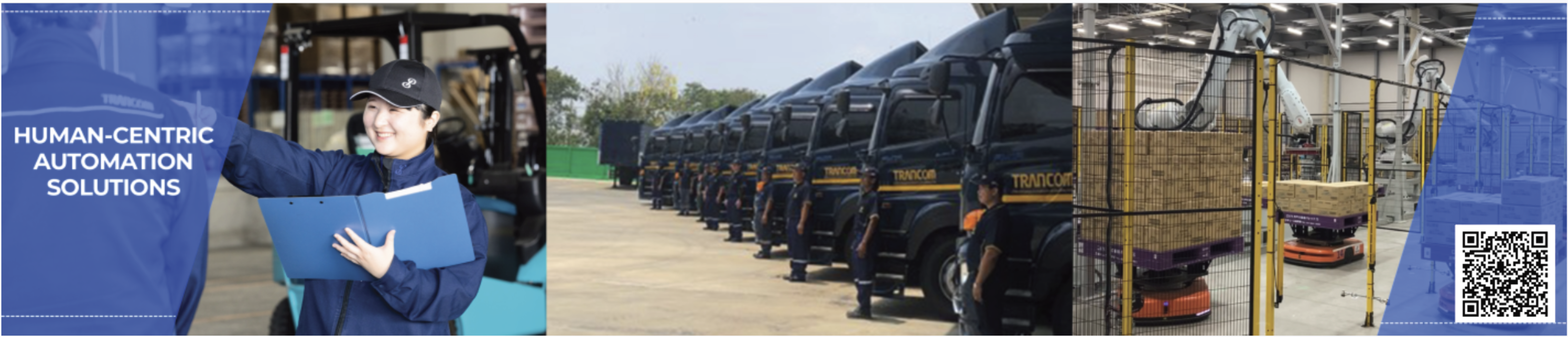
Trancom is also a pioneer in logistics automation, an urgent priority in light of Japan’s shrinking labor force. Drawing from its expertise in warehouse management, the company has obtained a patent for combining robotic systems to develop a novel automation solution. “What makes it unique is that it offers flexible, modular automation that cuts labor and costs by about 30% compared to normal and taking roughly half the floor space,” says Jinno. He emphasizes the importance of a hybrid model: “Because the system is not fully dependent on automation, it’s much more resilient in cases of power outages or system issues. This flexibility and real-world usability makes it stand out to our clients.”
While already maintaining a strong foothold across Japan, and providing logistics efficiency for a wide pool of customers, Trancom is actively seeking future potential growth. Looking ahead, Jinno envisions overseas expansion. He sees strong demand for high-quality logistics services across Asia: “Using Japan’s high-quality logistics standards, we launched our 3PL business in Thailand eight years ago in the daily necessities and hygiene product sectors, focusing on staff training and operational localization. Today, we not only provide 3PL services for domestic customers but have also expanded to offer ocean freight services.” Looking further afield, he adds: “From our base in Thailand, we aim to expand into other ASEAN countries and India. We’re targeting a market entry into India within the next five years.”